

Hebei Yueyang Electric Power Technology Co., Ltd. belongs to Beijing Beikai Zhongdian Group (established in 2005). It is a manufacturer of high and low voltage electrical equipment that integrates R&D, production, and sales. The company's main products include isolation switches, switchgear, vacuum circuit breakers, transformers, Drop Out Fuse, lightning arresters, and other series of products, which are widely used in ports, rail transportation, new energy, power systems, and infrastructure construction. These products are exported to over 60 countries and regions worldwide.

Our Advantages
Strong Production Capacity
Our company covers an area of about 20,000 square meters, has 30 factories and two branches, and has more than 100 employees. More than 20 years of production experience enable us to meet the diverse production needs of users.
Focus on Product Innovation
We continue to adhere to product innovation and technological innovation, established a technology research and development center, and obtained more than 60 utility model patents.
Advanced Production Equipment
Our company is equipped with 20 lathes, 10 universal cleaning machines, 8 drilling and washing machines, 5 punching machines, 9 experimental benches, 5 detectors, etc., to provide a guarantee for the high-precision production of products.
Recognized Product Quality
Our company has passed ISO9001 series system certification and has also established a product testing center. Reliable products have been sold to many countries and regions such as Europe, Africa, Southeast Asia, and the Middle East, and have been well received.


A drop-out fuse is a type of electrical protection device that is designed to disconnect the electrical circuit in the event of an overloading or short-circuit condition. Drop-out fuses are typically used in electrical systems to protect equipment and to prevent damage to the electrical system in the event of a fault.

Types of Drop-out Fuse
Cutout Fuses
Cutout fuses are used to protect transformers and other electrical equipment in an overhead power distribution network. They are designed to disconnect the electrical circuit in the event of an overloading or short-circuit condition and are typically installed at the point where the electrical equipment is connected to the power distribution network.
Pad-Mounted Fuses
Pad-mounted fuses are housed in a metal enclosure that is mounted on a concrete pad. They are typically used in outdoor electrical systems, such as those found in residential and commercial power distribution networks. Some pad-mounted fuses may include features such as thermal protection, overcurrent protection, and surge protection to ensure reliable and effective performance in a range of electrical applications.
Class R Fuses
Class R fuses are specifically designed for use in power distribution systems, including overhead power distribution networks. They are designed to handle high levels of current and are often used to protect large electrical equipment, such as transformers and motors. Class R fuses are relatively large and heavy, and are typically installed in fuse boxes or switchgear.
Class J Fuses
Class J fuses are designed for use in low-voltage electrical systems, including overhead power distribution networks. They are typically used to protect motors, transformers, and other electrical equipment. Class J fuses are available in a range of current ratings and are commonly used in industrial and commercial electrical systems.
Advantages of Drop Out Fuse
Protects Against Overloading
Drop-out fuses are designed to disconnect the electrical circuit if an excessive current flows through it. This protects electrical equipment and systems from damage during overloading, which can occur due to a variety of reasons such as a power surge, a fault in the electrical system, or an increase in the load on the system.
Improves Safety
By disconnecting the circuit in the event of an overloading or short-circuit condition, drop-out fuses help to prevent dangerous electrical conditions and improve the overall safety of the electrical system.
Easy to Replace
If a drop-out fuse blows, it is relatively easy to replace it with a new one. This helps to minimize downtime and maintain the reliability of the electrical system.
Cost-Effective
Drop-out fuses are a cost-effective solution for protecting electrical equipment and systems against overloading and short-circuits. They are less expensive than other types of protective devices, such as circuit breakers, and can be easily replaced if they blow.
Application of Drop Out Fuse

Power Distribution Systems
Residential Electrical Systems
Motors and Other Electrical Equipment
Lighting Circuits
Outdoor Electrical Systems
Agricultural Equipment
Uninterruptible Power Supply (UPS) Systems
The moving contacts at both ends of the fuse tube are fastened by the fuse (melt). After the upper moving contact is pushed into the protruding part of the “duck’s beak”, the upper static contact made of phosphor copper sheet is against the upper moving contact, so the fuse tube is firmly stuck in the “duck beak”. When the short-circuit current is fused through the fuse, an arc will be generated, and a large amount of gas will be produced by the steel paper tube lined with the fuse tube under the action of the arc. Because the upper end of the fuse tube is sealed, the gas will eject to the lower end to blow out the arc. Due to the fuse fusing, the upper and lower moving contacts of the fuse tube lose the binding force of the fuse. Under the action of the fuse tube’s own gravity and the upper and lower static contact spring pieces, the fuse tube falls down rapidly, so that the circuit is disconnected and the fault section line or fault equipment is cut off.
In the practical 10kV line system and the fuse on the distribution transformer can’t act correctly. One of the reasons is that the electrician’s quality is poor and the sense of responsibility is not strong. The maintenance and repair of drop out fuse is not carried out all the year round; the second reason is that the product quality of drop out fuse is poor and can not be operated flexibly. Two reasons reduce the function of drop out fuse. In reality, it is often found that there is lack of melting tube, lack of melt, or copper wire, aluminum wire or even iron wire hanging instead of melt. The trip out rate of the line and the fault rate of the distribution transformer remain high.
Turn off the Power
Before installing the fuse, make sure to turn off the power to the electrical system to ensure that there is no danger of electrical shock or damage to the equipment.
Identify the Location
Choose a location for the fuse that is easily accessible and allows for easy connection to the electrical system. It should also be protected from the elements and have adequate clearance for maintenance.
Mount the Fuse
Mount the fuse to the pole or other support structure using the appropriate hardware, such as bolts or brackets. Make sure that the fuse is securely mounted and will not move or vibrate.
Connect the Terminals
Connect the terminals of the fuse to the electrical system using the appropriate connectors, such as screws or plugs. Make sure that the connections are secure and properly tightened.
Check the Connections
Check all the connections to make sure that they are secure and properly installed. Also, check the fuse element and the operating mechanism to make sure that they are properly positioned and functional.
Restore Power
Once the fuse is installed and all the connections have been checked, turn the power back on to the electrical system.
Test the Fuse
Finally, test the fuse to make sure that it is working properly. This can be done by intentionally overloading the circuit or by using a test instrument to simulate a fault condition. If the fuse does not “drop out” or disconnect the circuit, then the installation may need to be checked or adjusted.
Voltage Rating
Ensure that the drop-out fuse has the appropriate voltage rating compatible with the electrical system it will protect. The voltage rating should match or exceed the system voltage.
Current Rating
Select a drop-out fuse with a current rating that aligns with the expected fault currents in the system. It should be capable of interrupting and safely handling the maximum fault current that may occur.
Type of System
Consider whether the drop-out fuse is intended for use in an AC or DC system. The type of system will affect the fuse's design and performance characteristics.
Interrupting Rating
The interrupting rating of the drop-out fuse should be suitable for the maximum fault current that the fuse may experience. It indicates the fuse's ability to safely interrupt the flow of current under fault conditions.


Fuse Type
Choose the appropriate type of drop-out fuse based on the application. Common types include expulsion fuses, which use a gas or oil expulsion mechanism to extinguish the arc, and arc-quenching fuses, which use arc-quenching materials.
Mounting Type
Consider the mounting type of the drop-out fuse, whether it is to be installed on a pole, crossarm, or within a substation. The mounting configuration should be suitable for the specific application and installation requirements.
Speed of Operation
Evaluate the speed of operation of the drop-out fuse. Different applications may require fast or time-delayed fuses based on the characteristics of the system and the desired protection scheme.
Environmental Conditions
Take into account the environmental conditions where the drop-out fuse will be installed. Factors such as temperature, humidity, and exposure to contaminants can impact the fuse's performance. Choose a fuse that meets the environmental requirements of the installation location.
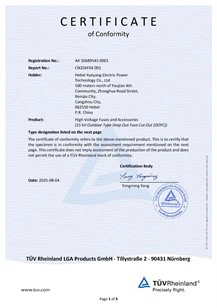
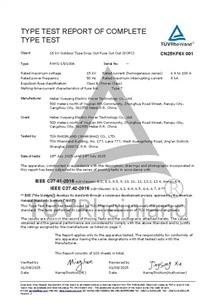
Our Certificate
Multiple certifications and product patents mean excellent product quality.

Ultimate FAQ Guide to Drop Out Fuse
Q: What are the advantages of drop out fuses?
Q: What is the drop out fuse in a pole mounted substation?
Q: What are the technical requirements before installing a drop out fuse?
Q: What is drop out fuse?
Q: What are the principles of drop-out fuses?
Q: What are the applications of dropout fuses?
Q: How to replace and maintain drop fuses?
Replacing a drop-out fuse is a straightforward process, thanks to its user-friendly design. First, the power must be disconnected to ensure the safety of maintenance personnel. The fuse carrier can then be removed from its holder, allowing access to the fuse tube. The damaged fuse tube can be easily replaced with a new one, and the carrier reinstalled in its original position. Once the replacement is complete, the power can be reconnected, and the system returned to normal operation.
Q: How to select and size a drop-out fuse?
Q: What are the advantages of drop-out fuses?
Q: What are the different types of drop-out fuses?
Q: What are the factors to consider when choosing a drop-out fuse?
Q: How does a drop out fuse protect a transformer?
Q: What are the precautions when operating drop-out fuses?
● When the gate is opened, the intermediate phase is first pulled off, then the leeward side phase is pulled, and finally the windward side phase is pulled off. This is because the distribution transformer is changed from a three-phase operation to a two-phase operation, and the arc spark generated by breaking the intermediate phase is the minimum, which will not cause phase-to-phase short-circuit. The second is to break the leeward side phase because the middle phase has been opened, the distance between the leeward side phase and the windward side phase is doubled. Even if there is overvoltage, the possibility of phase to phase short circuit is very small. Finally, when the windward side phase is pulled off, there is only capacitive current to the ground, and the generated spark is very slight.
● When closing, the sequence of operation is opposite, the windward side phase is closed first, then the leeward side phase is closed, and finally the intermediate phase is closed.
● The operation of the melting tube is a frequent item. If you don’t pay attention to it, the contact will be burned, and the contact will be overheated and the spring will be annealed, which will make the contact worse and form a vicious circle. Therefore, when pulling and closing the melting tube, the force should be moderate. After closing, carefully check that the duck’s beak tongue can tightly buckle more than two-thirds of the length of the tongue. You can hook the upper duck’s beak with a brake lever, press it down a few times, and then try to pull it gently to check whether it is closed properly. When the switch is not in place or not firmly closed, the pressure of the static contact on the fuse is insufficient, which will easily cause the contact to burn or the fuse tube to fall off.
Q: What are drop out fuses used along with?
Q: What are the disadvantages of a drop out fuse?
Q: How often do drop out fuses need to be replaced?
Q: How do you select the right drop out fuse for a specific application?
Q: Can fuses protect against surges?
As one of the leading drop out fuse manufacturers and suppliers in China, we warmly welcome you to buy cheap drop out fuse for sale here from our factory. All customized products are with high quality and low price.
fuse, fuse for generators, Drop Out Fuse price